

Selecting custom vinyl replacement windows for your home is one of the most impactful upgrades you can make to improve energy efficiency, interior comfort, curb appeal, and resale value. However, navigating California’s strict energy codes, diverse microclimates, and complex technical metrics can be daunting.
This comprehensive guide breaks down everything you need to know—from California Title 24 compliance and technical glass performance metrics to architectural matching, installation steps, and financial incentives—helping you make an informed decision for your home.

California’s Climate Zones & Energy Standards
Choosing custom vinyl replacement windows in California requires matching frame construction and glass low-E coatings to specific microclimates and Title 24 compliance standards. Coastal homes prioritize salt-air corrosion resistance, while inland and valley homes focus on low SHGC ratings to reflect high solar heat gain.
How does California Title 24 Part 6 affect vinyl window selection?
California’s Building Energy Efficiency Standards (Title 24, Part 6) set aggressive performance targets for residential fenestration to reduce statewide grid demand and carbon emissions. When installing replacement windows, your selection must meet or exceed prescriptive energy efficiency baselines determined by your specific California Climate Zone (ranging from Zone 1 in the far north to Zone 16 in the high mountains).
Title 24 regulates two primary window metrics: U-Factor (thermal insulation) and Solar Heat Gain Coefficient (SHGC) (solar radiation block). In most populated California regions, Title 24 mandates a prescriptive maximum U-Factor of 0.30 and a maximum SHGC of 0.23. Selecting high-performance vinyl windows with multi-layer Low-E glass coatings ensures complete code compliance, expedites municipal permitting, and maximizes thermal efficiency.
What visual and structural window options work best for Coastal vs. Inland California homes?
California’s microclimates demand tailored material formulations and glass configurations:
- Coastal California Homes (e.g., San Diego, Orange County, Los Angeles, Bay Area): Coastal properties face persistent marine environments, dense moisture, and airborne salt. Standard metal hardware rusts quickly, and low-quality vinyl can pit or discolor. Custom vinyl replacement windows with stainless steel or hardware treatments excel in coastal zones. Thermally, coastal homes benefit from balanced Low-E glass coatings that permit high visible light while insulating against cool marine layers and foggy mornings.
- Inland & Valley California Homes (e.g., Inland Empire, Central Valley, San Fernando Valley): Inland areas routinely experience extreme summer heat waves with temperatures exceeding 100°F. For these homes, structural stability and solar reflection are paramount. High-grade virgin vinyl with multi-chambered frame extrusions prevents thermal warping during intense heat. Thermally, these windows require triple-layer Low-E glass packages with ultra-low SHGC ratings (0.20–0.22) to reflect radiant solar heat before it enters the air-conditioned living space.
California Climate Zone Window Performance Specifications
| Region / Climate Zone | Target U-Factor | Target SHGC | Recommended Low-E Glass Coating | Recommended Frame Feature |
|---|---|---|---|---|
| Coastal (Zones 3, 5, 6, 7) | ≤ 0.27 – 0.30 | ≤ 0.25 – 0.28 | Dual-Coat Low-E (High Clarity) | Stainless steel hardware; heavy-duty vinyl welds |
| Inland Empire / Valley (Zones 8–13) | ≤ 0.26 – 0.28 | ≤ 0.20 – 0.22 | Triple-Coat Low-E (Low-E 366/Solar Control) | Multi-chambered extrusion; titanium dioxide UV stabilizers |
| Mountain / Alpine (Zones 14–16) | ≤ 0.22 – 0.25 | ≤ 0.30 (Passive solar retention) | Low-E with Argon Gas Fill | Heavy-wall vinyl; reinforced sash frame |
Technical Performance Metrics: Decoding U-Factor, SHGC, and Frame Specs
Key technical window metrics include U-Factor (measuring overall heat loss) and Solar Heat Gain Coefficient (SHGC, measuring solar radiation entry). For maximum efficiency in California, aim for a U-Factor of 0.27 or lower and an SHGC between 0.20 and 0.25.
What are the ideal U-Factor and SHGC ratings for California custom vinyl replacement windows in California?
To select high-performing custom windows, homeowners must understand ratings certified by the National Fenestration Rating Council (NFRC):
- U-Factor (0.20 to 1.20 rating scale): Measures the rate of non-solar heat transfer through the window assembly. A lower U-Factor indicates better insulating properties. In California, aim for a U-Factor of 0.27 or lower. Premium dual-pane vinyl windows filled with insulating Argon gas routinely achieve 0.24 to 0.26, preventing indoor heat from escaping during winter nights.
- Solar Heat Gain Coefficient / SHGC (0.00 to 1.00 rating scale): Measures the fraction of incident solar radiation admitted through a window. Lower numbers mean less solar heat enters your home. Because cooling dominates energy bills in most of California, an SHGC between 0.20 and 0.25 is ideal. A low SHGC significantly reduces air conditioning loads during sunny peak hours.
- Dual-Pane vs. Triple-Pane in California: While triple-pane windows offer superior soundproofing and ultra-low U-factors (down to 0.18), high-grade dual-pane windows with spectrally selective Low-E glass coatings are generally the most cost-effective solution for California’s mild-to-hot climate zones.
How does vinyl wall thickness (Mil thickness) and chamber design impact window longevity?
Not all vinyl window frames are created equal. The structural integrity, thermal resistance, and lifespan of a vinyl window depend heavily on vinyl chemistry and internal extrusion geometry:
- Virgin Vinyl vs. Recycled Vinyl: Premium custom replacement windows utilize 100% virgin vinyl (unplasticized PVC). Recycled vinyl often contains impurities that reduce structural elasticity, making frames brittle, susceptible to chalking, and prone to cracking under high temperature fluctuations.
- Vinyl Wall Thickness: High-performance vinyl windows feature thick structural walls (0.080 inches or 80–90 mils). Thicker exterior walls provide rigid structural framing, robust corner fusion welds, and long-term resistance to frame sagging or bow-ing over decades.
- Multi-Chambered Extrusions: Rather than being hollow, quality vinyl window frames feature multiple internal dead-air chambers. These multi-chambered designs create thermal barriers that stop heat conduction through the frame itself while adding structural rigidity without excessive weight.
What is Total Solar Reflectance (TSR) and why does frame color matter in sunny climates?
Total Solar Reflectance (TSR) measures the percentage of solar energy reflected by a material’s surface. In sun-drenched regions like Southern and Central California, exterior frame surfaces absorb high amounts of infrared radiation.
Historically, dark window frames absorbed high levels of heat, leading to vinyl frame expansion, warping, and finish peeling. Modern custom vinyl manufacturing overcomes this challenge using advanced heat-reflective exterior coatings blended with titanium dioxide (TiO₂) UV stabilizers. These engineered finishes maintain high TSR ratings even in dark bronze, black, or custom exterior colors, reflecting heat away from the frame structure to prevent thermal deformation and color fading.
Quick-Reference Window Metric Targets for California
- U-Factor: Target ≤ 0.27 (Measures heat transfer; lower is better)
- SHGC (Solar Heat Gain Coefficient): Target 0.20 – 0.25 (Measures solar heat entry; lower is better)
- VT (Visible Transmittance): Target ≥ 0.50 (Measures natural light daylighting; higher is better)
- CR (Condensation Resistance): Target ≥ 55 (Measures moisture resistance on glass; higher is better)
- STC (Sound Transmission Class): Target 32 – 35+ (Measures sound reduction; higher is better)
- Vinyl Wall Thickness: Target A-Grade / High-Performance (0.080″+ / 80–90 Mils)
Customization, Styles, and Architectural Compatibility
Custom vinyl replacement windows can be tailored to match any California architectural style—from Spanish Colonial to Modern Minimalist—using precise retro-fit or full-frame extrusions, multi-point locking hardware, obscure privacy glass, and factory-applied low-VOC exterior color finishes.
What custom window styles yield the highest ventilation and energy performance?
The operational style of your replacement windows impacts both airflow control and thermal seal tightness:
- Casement & Awning Windows: Casement windows hinge at the side and crank outward, while awning windows hinge at the top. Because wind pressure pushes the window sash tighter against the frame weatherstripping when closed, casement and awning styles offer the tightest air-leakage seals available, making them optimal for windward walls and energy efficiency.
- Single-Hung & Double-Hung Windows: Classic vertical sliding designs suited for Traditional, Craftmsan, or Cape Cod homes. Double-hung windows allow both upper and lower sashes to operate, enabling natural convection cooling (cool air enters the bottom sash while hot air escapes out the top sash).
- Sliding Windows: Horizontal sliders feature simple mechanical rollers and wide glass expanses, making them ideal for modern architectural styles, patio walls, and room openings where outward-cranking sashes would block exterior walkways.
- Picture Windows: Non-operational fixed windows that yield maximum energy efficiency, zero air leakage, and wide view corridors.

Can vinyl windows match historical or non-standard architectural designs?
Modern custom vinyl manufacturing allows homeowners to preserve historical aesthetics or complement unique architectural homes:
- Architectural Shapes & Curves: Custom vinyl extrusions can be precision-bent during manufacturing into arches, half-rounds, eyebrows, octagons, and custom trapezoid shapes.
- Grid Options: To emulate traditional divided-lite window frames, vinyl windows offer Grids Between Glass (GBG) for effortless exterior cleaning, or Simulated Divided Lites (SDL), where dimensional grid bars are permanently adhered to both exterior surfaces of the glass for high shadow-line architectural realism.
- Color & Finish Customization: Gone are the days of plain white vinyl. Modern factories utilize co-extruded color layers and solar-reflective polyurethane finishes, offering interior woodgrain finishes and exterior tones such as bronze, black, silver, beige, and espresso.
What glass package upgrades are available for soundproofing and UV protection?
Beyond simple energy savings, custom glass packages enhance lifestyle comfort:
- Acoustic Sound Dampening (High STC Ratings): For California homes near busy freeways, urban centers, or flight paths, acoustic glass upgrades reduce ambient noise noticeably. Sound reduction is achieved through Dissimilar Glass Thicknessing (e.g., combining 1/8″ glass with 3/16″ glass to disrupt different sound wave frequencies) or incorporating Laminated Glass interlayers, achieving Sound Transmission Class (STC) ratings of 35 to 40+.
- 99% UV Protection: Standard clear glass lets harmful ultraviolet (UV) radiation fade interior hardwood flooring, furniture, rugs, and artwork. Modern multi-layer Low-E coatings filter up to 95%–99% of damaging UV rays without reducing visible daylighting inside the home.
Custom Vinyl Replacement Windows & Installation Process Step-by-Step
Professional vinyl window installation involves precise opening measurement, selecting flush-fin retro-fit or nail-fin replacement frames, applying continuous flashing and high-grade polyurethane sealant, ensuring perimeter shimming, and verifying plumb, level, and square operation.
What is the difference between Retrofit (Flush Fin) and Full-Frame (Nail Fin) replacement?
Choosing the correct installation methodology protects your home’s water barrier and structural integrity:
- Retrofit Installation (Flush Fin / Z-Bar): Retrofit installation is the preferred, cost-effective method for typical California homes with existing exterior stucco, masonry, or brick. The original window sashes and inner aluminum/wood frame are removed, but the original perimeter frame embedded inside the wall remains untouched. The new vinyl window features a wide exterior “flush fin” (or Z-bar) that overlaps the existing exterior wall surface. High-grade elastomeric sealant creates a continuous waterproof seal between the new fin and exterior wall. This method prevents damaging exterior stucco during removal.
- Full-Frame Replacement (Nail Fin / New Construction Style): Full-frame replacement involves completely tearing out the old window down to the structural wall studs, removing interior trim, and cutting back exterior siding or stucco by several inches. The new window features a nail fin that fastens directly to the rough framing studs, followed by complete self-adhering flashing tape application. Full-frame replacement is recommended when there is wood rot, structural framing damage, or during comprehensive home remodels.
What are the critical steps in a quality window replacement installation?
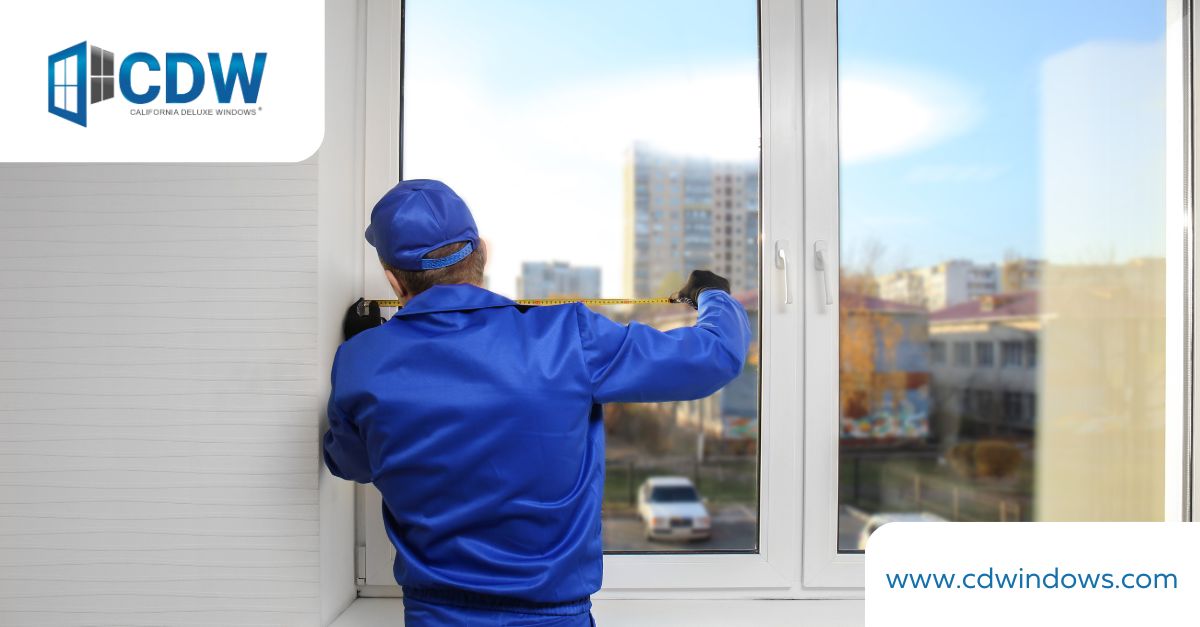
- Precision In-Home Measurement & Structural Assessment: Installers capture millimeter-accurate measurements of every opening (checking for level, plumb, and squareness) before ordering custom factory fabrications.
- Custom Factory Fabrication & Quality Control: The window is manufactured to exact custom dimensions, ensuring tight tolerances without forcing frames during installation.
- Existing Window Removal & Opening Preparation: Sashes and frame components are carefully detached without damaging interior drywall or exterior siding. The rough opening is cleaned of old caulking, dust, and debris.
- Waterproof Flashing & Thermal Insulation: High-grade flashing tape and continuous weather barriers are integrated across the sill. Low-expansion polyurethane window foam is injected into perimeter gaps to form a thermal barrier.
- Window Insertion, Leveling, Shimming, & Fastening: The custom vinyl window is set on non-compressible composite shims, leveled, squared, and secured to the rough framing using non-corrosive structural fasteners.
- Perimeter Sealant, Trim Integration, & Inspection: Commercial-grade, UV-resistant polyurethane sealant is applied around exterior fins. Interior trim or stops are installed, followed by operational tests of hardware, locks, and balances.
How long does custom window manufacturing and installation usually take?
The timeline from initial consultation to final completion follows three distinct phases:
- In-Home Consultation & Measurement: 1 Day
- Custom Factory Manufacturing & Assembly: 2 to 4 Weeks (depending on custom colors, special glass orders, or grid configurations)
- On-Site Installation: Most residential installations are completed in 1 to 2 days. Experienced installation crews typically install 8 to 12 windows per day, minimizing disruption to your home.
Cost Breakdown, Energy Savings, & California Rebates / ROI
The cost of custom vinyl replacement windows in California typically ranges from $650 to $1,500+ per window installed, depending on size, glass package, and frame finishes. Homeowners often recover up to 70–75% of the cost at resale while cutting utility bills by 12–15%.
How much do custom vinyl replacement windows cost in California?
The cost of replacing windows in California varies based on size, customization, glass package, and structural installation needs. On average, homeowners pay between $650 and $1,500 per window fully installed.
Primary price drivers include:
- Window Dimensions & Operating Style: Standard sliding windows are the most economical (650–950 installed), while large casements, bay windows, or custom architectural shapes range higher (1,100–2,200+ installed).
- Glass Upgrades: Triple-pane glass, laminated acoustic interlayers, or specialty solar control Low-E coatings add 15%–30% to base window production costs.
- Exterior Color Finishes: Standard white interior/exterior vinyl is most cost-effective; custom exterior color coatings (e.g., matte black or architecturally matched bronze) carry a 15%–25% premium.
- Installation Complexity: Second-story windows, full-frame tear-outs requiring stucco patching, or repair of dry rot increase labor costs.
Are there California energy efficiency rebates or Federal Tax Credits for replacing windows?
Homeowners can offset upfront replacement costs through federal tax credits and regional rebate programs:
- Federal Energy Efficient Home Improvement Credit (Section 25C): Under the Inflation Reduction Act, homeowners who install Energy Star-certified windows can claim a federal tax credit equal to 30% of the product cost, up to a maximum credit of $600 per year. Windows must meet Energy Star Most Efficient criteria for your regional zone.
- Local Utility Rebates & Regional Programs: Various municipal electric utilities and regional energy initiatives (such as TECH Clean California or local REN programs) offer rebates ranging from $50 to $200 per window when replacing inefficient single-pane glass with qualifying high-performance Low-E vinyl windows.
What is the average ROI and utility bill savings after replacing old windows?
Replacing single-pane or leaky aluminum windows yields high long-term financial returns:
- Utility Bill Savings: According to U.S. Department of Energy estimates, replacing single-pane windows with Energy Star-certified vinyl windows saves California homeowners an average of 12% to 15% on monthly heating and cooling costs, equating to hundreds of dollars in annual utility bill reductions.
- Resale Home Value & Equity: The Cost vs. Value Report consistently ranks vinyl window replacement as one of the highest-ROI interior/exterior home upgrades. Homeowners typically recoup 70% to 75% of total project costs in added property appraisal value at resale, alongside the immediate boost to home curb appeal.
Maintenance, Warranties, & Long-Term Care
Custom high-grade vinyl windows require minimal maintenance—periodic cleaning with mild soap and water, lubrication of tracks and balance shoes, and inspecting perimeter caulking ensures peak performance and maintains full lifetime warranty coverage.
How do you properly clean and maintain custom vinyl window frames and glass?
Vinyl windows require minimal upkeep to operate smoothly for decades. Follow these core care guidelines:
Vinyl Window Maintenance Checklist
Do’s
- Do clean vinyl frames using a soft cloth or sponge with mild dish soap and warm water.
- Do clear dirt, sand, and organic debris out of bottom tracks and weep holes twice a year.
- Do spray track rollers, hinges, and balance shoes with a dry silicone lubricant annually.
- Do inspect exterior perimeter caulking and caulking seals for gaps or wear once a year.
Don’ts
- Don’t use abrasive pads, steel wool, or harsh chemical cleaners (e.g., bleach, ammonia, paint thinner) that can scratch or damage the vinyl finish.
- Don’t use high-pressure power washers to clean window exteriors, as high-pressure spray can compromise insulated glass unit seals or force water past weatherstripping.
- Don’t paint vinyl window frames with standard latex or oil paints, as unapproved paints can trap solar heat and void manufacturer frame warranties.
What should a comprehensive lifetime vinyl window warranty include?
A true professional-grade window warranty should protect your investment against material defects, operational failure, and installation issues over the long term:
- Lifetime Frame Warranty: Covers vinyl frame cracking, peeling, blistering, warping, or chalking under normal solar exposure.
- Insulated Glass Unit (IGU) Seal Failure: Guarantees against seal degradation that causes glass fogging, moisture intrusion, or internal dust buildup between panes (typically covered for 20 years to lifetime).
- Hardware Coverage: Covers locks, latches, balances, handles, and rollers against mechanical binding or failure.
- Labor & Workmanship Coverage: Protects against installation leaks, improper shimming, or air infiltration issues.
- Transferability: A quality warranty should be transferable to a new homeowner if you sell your property, providing an extra selling point to potential buyers.
How long do vinyl replacement windows last in high-sun environments?
When manufactured using high-grade virgin vinyl formulated with titanium dioxide (TiO₂) UV inhibitors, custom vinyl replacement windows have an expected service life of 30 to 50 years. Unlike wood (which rots, warps, and requires repainting) or aluminum (which corrodes and conducts heat), modern vinyl maintains structural strength, color fidelity, and thermal efficiency through decades of intense exposure to California heat and sunlight.