

Soundproof acoustic glass custom windows are specialized, precision-engineered window assemblies designed to dissipate sound energy before it enters a home. Unlike builder-grade windows with uniform glass thickness, acoustic windows utilize asymmetrical glass pane construction (panes of differing thicknesses), viscoelastic Polyvinyl Butyral (PVB) laminated interlayers, expanded argon gas air spaces, and multi-chambered vinyl framing.
They achieve Sound Transmission Class (STC) ratings of 40 or higher, reducing perceived exterior noise by up to 75% to 90% across high, mid, and low frequencies.
Excessive exterior noise in residential neighborhoods disrupts sleep patterns, elevates chronic stress levels, and degrades quality of life. For homeowners near high-density traffic arteries, transit corridors, or bustling commercial districts, standard builder-grade windows act as acoustic conduits rather than protective barriers.
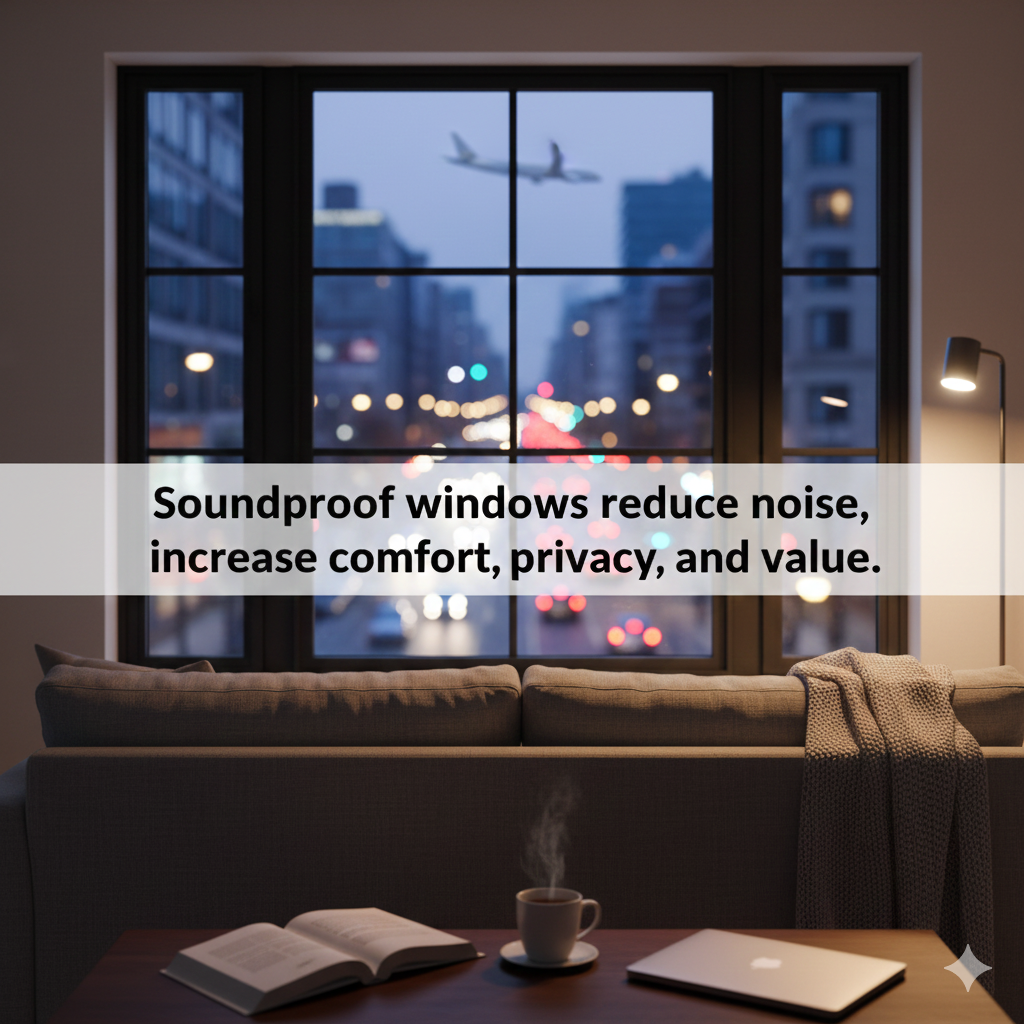
Standard double-pane windows feature thin, identical glass panes with narrow air gaps. When hit by sound pressure, matching glass panes resonate at identical frequencies, a physical phenomenon known as sympathetic vibration, effectively transmitting noise directly into your home.
STC Ratings: Sound Transmission Class Decoded
Evaluating acoustic insulation performance requires analyzing the Sound Transmission Class (STC) rating. The STC rating is an integer rating that measures an architectural component’s ability to attenuate airborne sound across standard frequencies (125Hz to 4000Hz). Higher STC values correspond to greater sound reduction.
Because the decibel (dB) scale is logarithmic, every 10dB increase in sound attenuation represents a 50% reduction in perceived loudness to the human ear.
Soundproof Acoustic Glass Custom Windows Performance Comparison:
| Window Assembly Type | Typical STC Rating | Decibel (dB) Attenuation | Perceived Exterior Noise Reduction | Primary Acoustic Vulnerability |
|---|---|---|---|---|
| Single-Pane Window (3mm glass) | 20 – 28 | 15 – 22 dB | Minimal (0% – 20%) | High susceptibility to all frequencies; zero wave damping. |
| Standard Dual-Pane (3mm/Air/3mm) | 28 – 32 | 22 – 28 dB | Moderate (25% – 40%) | Resonates at matching frequencies; poor low-frequency performance. |
| Enhanced Dual-Pane (3mm/Air/6mm) | 33 – 36 | 28 – 33 dB | Substantial (50% – 65%) | Mitigates mid-frequency hums; limited against deep rumbles. |
| Acoustic Laminated Custom Window (6mm PVB Laminated) | 40 – 48+ | 38 – 48+ dB | Exceptional (75% – 90%+) | Heavy-duty damping blocks sirens, jet engines, and freeway hum. |

Mechanics of Acoustic Glass: How PVB Interlayers Dampen Sound
Soundproof windows are more energy efficient windows. Sound travels as mechanical pressure waves through air. When these waves hit a solid structure like a window pane, they force the glass to flex, transferring energy from the exterior pane to the internal air gap and through to the interior pane.
Soundproof acoustic custom windows disrupt this transfer mechanism through four primary engineering pillars:
- Viscoelastic Damping via PVB Interlayers: A custom soundproof glass unit incorporates a flexible Polyvinyl Butyral (PVB) interlayer bonded between two sheets of glass. As acoustic waves strike the outer glass, the PVB layer flexes under shear strain, converting kinetic vibrational energy into microscopic amounts of thermal energy (heat).
- Asymmetrical Glass Construction: Combining glass panes of unequal thickness (e.g., 6mm exterior pane paired with a 4mm interior pane) forces sound waves to traverse dissimilar mass densities. Because each pane possesses a distinct natural resonance, sound waves cannot easily induce sympathetic vibration across the entire unit.
- Expanded Interpane Air Spaces with Inert Argon Gas: Widening the gap between glass panes to 1/2inch or 3/4inch and filling it with dense Argon gas slows the speed of sound waves as they transfer between glass sheets, dampening acoustic pressure before it reaches the home.
- Multi-Chambered Vinyl Frame Extrusions: Custom-extruded, heavy-wall vinyl window frames feature isolated internal air chambers. These multi-chambered frames isolate frame-borne vibrations and eliminate perimeter “flanking noise” (sound traveling around the glass through hollow frame materials).
Target Frequency Attenuation Across Regional Environments
Noise sources emit sound across different point-frequency spectrums. Soundproofing requires matching the window assembly to the specific microclimate and environmental noise signals of the site.
Microclimates and Hyper-Local Noise Signals
- Freeway & Transit Corridors (Low-Frequency 20Hz-250Hz): Residences adjacent to continuous California transit corridors like US-101, I-405, I-5, or Wilshire Boulevard suffer from low-frequency diesel engine rumbles and tire hums. Long wavelengths pass through rigid structures. Mitigating these sounds requires max-mass asymmetrical glass (6mm to 8mm laminated exterior panes) combined with expanded argon-filled gaps.
- Urban Commercial Centers & Nightlife (Mid-Frequency 250Hz-2000Hz): Urban infill zones, commercial strips, and high-density neighborhoods encounter irregular noise spikes—pedestrian chatter, late-night deliveries, and music. The viscoelastic PVB interlayer core targets human speech and ambient street noise.
- Flight Paths & Light Rail Corridors (High-Frequency 2000Hz+): Coastal microclimates near airports (LAX, SFO, SAN) and properties along light rail lines face high-frequency propulsion noise and metal-on-metal track friction. Multi-pane assemblies combined with heavy perimeter compression weatherstripping eliminate high-pitch sound wave penetration.
Retrofitting with Stucco Flush-Fin Installations & Title 24 Compliance
Upgrading to acoustic glass also enhances thermal insulation throughout the residential envelope, helping fulfill strict California Title 24 Building Energy Efficiency Standards.
Thermal & Structural Synergy
- Title 24 Compliance: Custom acoustic units combine PVB laminated glass with spectrally selective Low-Emissivity (Low-E) coatings and low-conductive argon gas. This lowers the U-Factor (thermal conductivity) and Solar Heat Gain Coefficient (SHGC), keeping homes cooler during intense summer heat spikes and warmer in winter.
- Non-Invasive Stucco Retrofit: In traditional California homes with exterior stucco, replacing windows once required invasive wall demolition, damaging exterior masonry and stucco coats. Flush-fin (or stucco fin) retrofit techniques allow custom vinyl frames to mount cleanly over existing frames.
- Perimeter Flanking Seal: Precision measurement ensures a tight fit, while dual-compression weatherstripping and high-density expandable polyurethane foam eliminate air micro-gaps—blocking acoustic leaks and draft penetration simultaneously.
How much noise reduction can I expect from acoustic laminated windows?
Replacing standard single-pane or basic dual-pane windows with STC 40+ soundproof acoustic glass custom windows reduces perceived indoor noise by 75% to over 90%. This converts high-volume 80dB exterior street noise (equivalent to continuous freeway traffic or freight trains) down to an interior level of 35-40dB, which matches the ambient quiet of a rural library.
Soundproof Acoustic Glass Custom Windows: Frequently Asked Questions
What is the difference between standard double-pane glass and acoustic laminated glass?
Standard double-pane glass uses two panes of identical thickness separated by air space. Because both panes are identical, they vibrate at the same resonant frequency, transmitting sound. Acoustic laminated glass uses panes of varying thickness (asymmetrical construction) and embeds a viscoelastic PVB interlayer between the glass layers, absorbing sound vibrations and converting kinetic energy into heat.
Will soundproof windows block low-frequency truck and freeway noise?
Yes, but blocking low-frequency noise requires specific configurations. Low-frequency sound waves (like deep diesel rumbles or heavy traffic on I-405 or US-101) have long wavelengths that pass through thin glass. To suppress them, windows require thick asymmetrical laminated glass (e.g., 6mm or 8mm laminated exterior pane) combined with a 1/2inch or wider argon-filled space.
Do soundproof acoustic windows also improve home energy efficiency?
Acoustic windows improve energy efficiency. The same features that block sound—laminated glass layers, expanded argon gas fills, multi-chambered vinyl frames, and airtight seals—also block thermal heat transfer. When paired with spectrally selective Low-E coatings, acoustic windows meet or exceed California Title 24 requirements, lowering HVAC energy usage year-round.
Can soundproof custom windows be installed without damaging my home’s exterior stucco?
Yes. Utilizing specialized stucco retrofit (flush-fin) custom window installation techniques, factory-trained installers mount the custom vinyl frame over the existing window frame. This creates an airtight, watertight seal without cutting into exterior stucco walls or requiring costly masonry repairs.