

California sunshine is one of the state’s greatest assets, but it also presents a real challenge for homeowners. UV radiation can enter your home every day through ordinary windows, fading flooring, damaging furniture, and even increasing the health risks. At California Deluxe Windows (CDW®), we engineer UV protection windows that address all of this and more.
Our custom vinyl windows are built with advanced Low-E glass technology and spectrally selective coatings to block up to 99% of harmful ultraviolet rays, without darkening your interiors or sacrificing the natural light that makes your home feel alive.
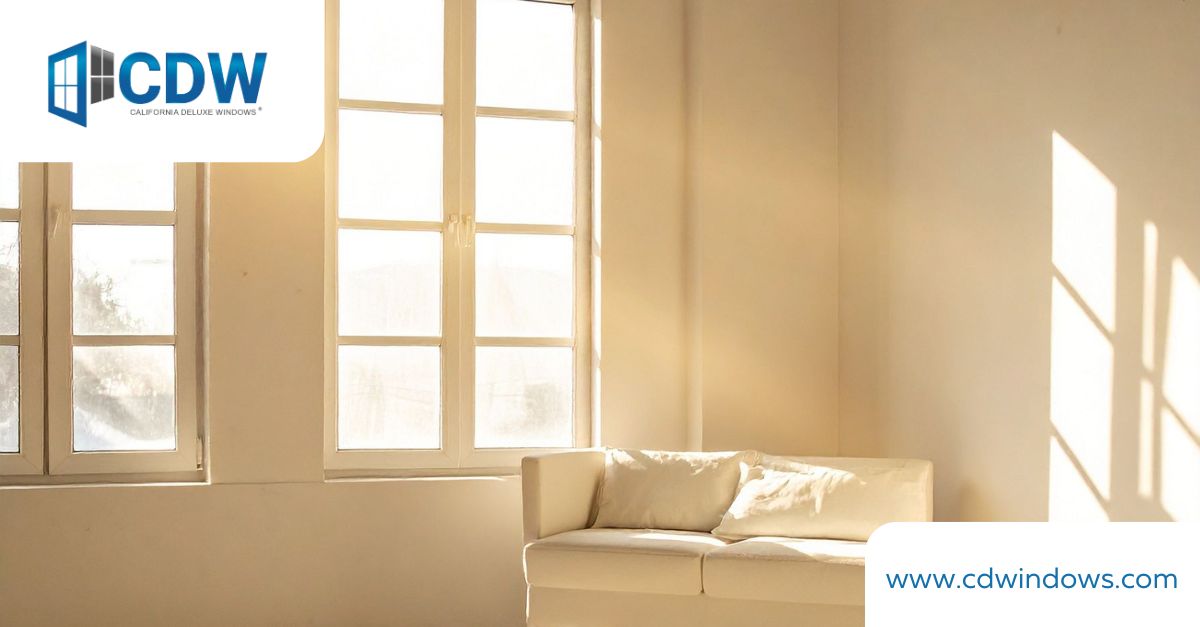
UV Radiation and Your Home’s Interior
Most homeowners think of UV damage as something that can only be damaging outdoors (as explained by this NIH article). In reality, ultraviolet radiation passes through conventional glass with very little resistance, reaching your carpets, hardwood floors, upholstered furniture, window treatments, and the family members who spend time near windows.
The Difference Between UVA and UVB Rays
According to the U.S. Environmental Protection Agency (EPA), the UV radiation that reaches the Earth’s surface consists primarily of two types: UVA and UVB. UVA rays carry the longest wavelength and penetrate the deeper layers of skin. The atmosphere does very little to filter UVA, which means nearly all of it reaches ground level, and, critically, most of it passes straight through standard window glass into your living spaces.
UVA exposure is linked to skin aging, eye damage, and a heightened risk of skin cancer. UVB rays have a shorter wavelength and are primarily responsible for sunburns and surface skin damage. While the atmosphere absorbs a greater proportion of UVB than UVA, meaningful levels still penetrate interior spaces through unprotected glass.
The Skin Cancer Foundation confirms that UVA rays pass through standard window glass and create a measurable risk for people who spend extended time near windows. This is all the more reason to have the right custom windows.
How the California Sun Accelerates Solar Fading
California receives some of the highest UV index readings in the continental United States, according to the EPA. Cities like Beverly Hills, Tarzana, West Hollywood, and communities throughout the San Fernando Valley experience intense, direct sun for the majority of the year.
When UV radiation reaches interior surfaces, it breaks down the chemical bonds in dyes, pigments, and organic materials.
The result is faded hardwood floors, bleached upholstery, and deteriorating artwork. UV-induced solar fading is cumulative: each year of unprotected sun exposure compounds the damage, making it one of the costliest and most overlooked problems California homeowners face.
The Science Behind California Deluxe Windows’ UV-Blocking Technology
We do not rely on a single technology to achieve UV protection. Our windows combine multiple engineered systems, Low-E glass coatings, insulated glass units, and gas fills, that work together to deliver measurable, lasting performance. Here is how each component contributes.
Advanced Low-E (Low-Emissivity) Glass Coatings
Low-E glass is the foundation of any serious UV-blocking window. A Low-E coating is a microscopically thin metallic layer, approximately 500 times thinner than a human hair, applied to the glass surface. While completely invisible to the naked eye, it has a dramatic effect on the type of energy that passes through the glass.
Ordinary clear glass has a high emissivity of approximately 0.84, meaning it permits the free transfer of radiant heat and ultraviolet radiation. High-performance Low-E glass can reduce emissivity to as low as 0.02, reflecting infrared heat back toward its source while maintaining strong Visible Light Transmittance (VLT) so your interiors remain bright and welcoming.
Our spectrally selective coatings extend this capability by targeting the specific wavelengths of the solar spectrum responsible for UV damage and unwanted heat gain, allowing natural daylight to enter while filtering out what harms your home.
A low Solar Heat Gain Coefficient (SHGC) is central to this approach: it measures how much solar energy passes through the glass as a whole, and the lower the value, the less UV-laden heat penetrates your interior.
Double-Pane and Triple-Pane Insulated Glass Units (IGUs)
The Low-E glass coating alone does not complete the picture. Our UV protection windows are constructed as insulated glass units (IGUs), sealed assemblies of two or three glass panes separated by a thermally efficient spacer.
In a double-pane IGU, the sealed cavity between the panes acts as an insulating barrier, reinforcing the UV and heat-blocking work performed by the Low-E coating. Triple-pane configurations introduce a third lite of glass, adding a further layer of both UV protection and thermal insulation.
This makes triple-pane IGUs a particularly strong choice for homes in areas with more pronounced temperature variation, including communities throughout the greater Bay Area such as Concord, Fremont, and Santa Clara.
Sealing the Low-E coating within an IGU also protects it from environmental exposure, preserving its performance for the full service life of the window without degradation.
The Role of Argon and Krypton Gas Fills
To maximize thermal performance within the sealed cavity of an IGU, we use argon and krypton gas fills in place of ordinary air. Both gases are denser than air, which slows the rate of heat transfer through the window assembly.
Krypton gas fill achieves even greater performance gains, up to 27% over an air-filled unit, and is particularly effective in thinner-profile IGUs. The result is a window system that performs at a significantly higher level across California’s full range of climates.
Benefits of Upgrading to UV Protection Windows
CDW’s UV protection windows deliver value across multiple areas of your home life simultaneously. Each improvement reinforces the others, creating a result that is greater than the sum of its parts.
Preserving Luxury Flooring, Furniture, and Artwork
Hardwood floors, premium carpets, leather furniture, original artwork, and fine fabrics represent substantial investments. When standard windows allow UV radiation and solar heat to reach these surfaces year after year, the damage accumulates and becomes irreversible.
Our Low-E glass and spectrally selective coatings block up to 99% of the UV rays responsible for solar fading, extending the lifespan of your interior materials significantly. For homeowners who have invested in high-quality interiors, our UV-blocking vinyl windows are among the most cost-effective ways to protect that investment over the long term.
Lowering Energy Bills Across California’s Diverse Climates
The U.S. Department of Energy estimates that windows can account for a significant percentage of a building’s total heating and cooling energy use. By combining Low-E coatings with argon gas fills and a low SHGC, our windows significantly reduce the solar heat entering your home during summer while helping retain indoor warmth during cooler months.
This translates to lower HVAC demand and meaningfully reduced energy bills throughout the year. As a proud ENERGY STAR partner, California Deluxe Windows meets the rigorous energy performance criteria set by the program, providing our customers with confidence that every window we install has been evaluated against a credible national standard.
Protecting Your Family from Indoor UV Exposure
Families who spend long hours at home, working near windows, homeschooling children, or relaxing in sun-facing rooms, accumulate meaningful UV exposure through standard glass over time.
Our UV protection windows dramatically reduce this exposure by blocking the UVA radiation that ordinary glass does nothing to stop, providing a practical, passive layer of protection for every member of your household throughout the day.
Reducing Ambient Noise and Enhancing Home Security
The same insulated glass unit construction that delivers UV protection and thermal performance also creates a denser acoustic barrier between your home and the outside environment. For homeowners in urban neighborhoods or near high-traffic corridors, this translates to noticeably quieter interiors.
Our custom vinyl frames are precision-engineered to fit your exact opening dimensions, eliminating gaps that allow both sound and air infiltration. The structural integrity of our multi-pane window assemblies also contributes to home security, offering greater resistance to forced entry compared to single-pane alternatives.
Engineered Specifically for Northern and Southern California Climates
California is not a single climate, it is dozens. A window optimized for the coastal air of Sonoma performs differently from one designed for the intense inland heat of Chatsworth.
We engineer our UV protection windows with California’s regional diversity in mind, selecting Low-E glass formulations, SHGC values, and gas fill configurations that align with the specific demands of your location.
Beating the Inland Heat: From Chatsworth to the San Fernando Valley
Inland Southern California communities like Chatsworth and the broader San Fernando Valley experience extended periods of intense solar radiation and elevated ambient temperatures. In these locations, a low SHGC is especially important: it limits how much solar energy penetrates the glass assembly, reducing the load on your air conditioning system while simultaneously cutting the UV exposure reaching your interiors.
Our Low-E coatings are particularly well-suited to these conditions, delivering high VLT so rooms remain bright and livable while keeping heat and ultraviolet radiation where they belong, outside.
Protecting Coastal and Greater Bay Area Homes: From Santa Clara to San Jose
Coastal and Bay Area communities, including Santa Clara, San Jose, Concord, Fremont, Sonoma, and neighborhoods throughout Silicon Valley, experience a different solar profile than inland Southern California.
Seasonal fog and marine layer moderate temperatures, but UV radiation persists even on overcast days. Our IGUs with argon gas fills are well-matched to the Bay Area’s variable climate, maintaining consistent thermal insulation through temperature fluctuations while providing continuous ultraviolet radiation protection regardless of sky conditions.
Why In-House Manufacturing Makes the Difference for UV Protection
Achieving genuine UV protection in a custom vinyl window requires precise coordination between the glass specification, the frame fabrication, and the installation process itself. When these stages are handled by separate companies, the opportunity for misalignment multiplies at every handoff.
At CDW, we control every stage of production in our own facility, giving you a level of quality control that outside vendors simply cannot match.
Our manufacturing team has refined this process for more than 30 years, building every window to your home’s exact dimensions and selecting the ideal Low-E glass coating, gas fill, and frame configuration for its orientation, solar exposure, and regional California climate.
Choosing the Right Style of UV-Blocking Windows for Your Architecture
UV-blocking performance is built into every window we manufacture, regardless of style. This means you do not have to choose between the aesthetic your home deserves and the protection your household needs.
Whether your architecture calls for a classic double-hung window or a sweeping curved bay, every option we offer delivers the same Low-E glass technology and insulated glass unit manufacturing.
Frequently Asked Questions About UV Protection Windows
Do UV windows block natural light or make a room dark?
Our UV protection windows are specifically engineered to maintain high Visible Light Transmittance (VLT) while blocking UV radiation and reducing heat gain. The spectrally selective Low-E coatings we use target the ultraviolet and infrared portions of the solar spectrum without meaningfully reducing the visible daylight that enters a room.
Most homeowners find that spaces fitted with our windows actually feel brighter than before, because the coatings reduce glare and harsh solar heat without diminishing the quality or character of natural light.
Can energy-efficient windows completely stop furniture from fading?
No window system eliminates solar fading entirely, because visible light itself, not UV alone, contributes to the process over very long timeframes. What our UV protection windows do is block up to 99% of the UV radiation that causes the overwhelming majority of fading damage.
The cumulative effect of this protection is significant: flooring, upholstery, and artwork that would otherwise show visible deterioration within a few years can retain their original color and quality for far longer under our UV-blocking glass.
What is the difference between standard glass and UV-blocking Low-E glass?
Standard clear glass transmits the majority of UVA rays, the type that penetrates without triggering a sunburn sensation but still damages skin, fades materials, and contributes to cumulative health risk.
Low-E glass uses a precision metallic coating to reflect infrared heat and block a substantial portion of UV radiation while preserving natural light and visual clarity. The performance gap between standard glass and our Low-E insulated glass units is measurable in both energy costs and interior preservation over the full life of the windows.
How long do the UV-blocking properties of custom vinyl windows last?
When we properly seal a Low-E coating within an insulated glass unit, it stays protected from the environment on both sides of the glass pane. You do not need to perform any maintenance to preserve its UV-blocking properties.
What is the difference between UVA and UVB rays?
UVA rays have longer wavelengths and penetrate deeper into the skin, while UVB rays are primarily responsible for sunburn. Standard window glass blocks some UVB, but much of the UVA radiation can still enter a home.
How do insulated glass units improve window performance?
Insulated glass units use two or three panes of glass separated by a sealed air or gas-filled space. This construction improves thermal insulation, supports UV-blocking performance, and helps maintain consistent indoor comfort.
What role do argon and krypton gas fills play?
Argon and krypton are denser than ordinary air, which slows heat transfer through the window assembly. This added insulation can improve energy efficiency and enhance overall window performance in both coastal and inland climates.
Can UV protection windows reduce energy bills?
Yes. By limiting solar heat gain during hot weather and helping retain indoor warmth during cooler periods, energy-efficient UV-blocking windows can reduce the workload on heating and cooling systems throughout the year.