

When a window fails, it is rarely a single component that gives way. Rather, it is the result of several shortcuts too many that were taken at the factory. At California Deluxe Windows, that doesn’t happen. We eliminate that risk because we do all of our own window manufacturing. So, the same professionals that give you the free estimate also manufacture and even install your windows.
With over 30 years of experience serving homeowners, every window we produce is engineered from raw material to finished frame all under one roof. That way, we can ensure all of our windows meet our quality standard.

The Anatomy of a High-Performance Window: Material Science
The performance of any window begins long before it reaches your home. It begins with the raw material, and at CDW, that material is solid uPVC vinyl. This is a compound we formulate specifically for superior impact resistance, dimensional stability, and long-term weatherability.
Standard vinyl windows often use hollow chambers and thin extrusion walls. Our finished extrusions feature wall construction up to 40% thicker than competing brands. That delivers a structural foundation that holds its shape across decades of use. Simply put, we manufacture our windows to last.
What Separates uPVC From Conventional Vinyl and Wood
Unlike wood, uPVC does not swell when exposed to moisture, will not rot, will not attract termites, and never requires painting or re-glazing. Unlike standard metal or aluminum frames, it cannot rust, flake, or corrode when exposed to salt spray or pool chlorine.
Our proprietary uPVC formula includes UV-stabilizing additives that prevent the yellowing and surface degradation common in lesser vinyl products, so your windows retain their appearance for the life of your home.
For homeowners who want the warmth of a wood aesthetic without any of its upkeep demands, our Liquid Wood finish delivers a factory-applied wood-grain texture directly onto the uPVC substrate.
The result is a window that captures the character of timber while retaining every performance advantage of vinyl, a combination that no genuine wood window can match. Because the color and finish are integral to the extrusion process rather than applied as a coating, the appearance remains consistent even if the surface is ever scratched.
Step-by-Step Inside the CDW Manufacturing Process
Factory ownership gives us something the rest of the replacement window industry cannot easily replicate: complete visibility into every stage of production.
From the moment raw uPVC compound enters our Chatsworth facility to the moment a finished sash leaves on a delivery vehicle, each process is monitored, calibrated, and executed by our own team.
Our fabrication plants operate on a computer-integrated manufacturing platform. Glass cutting is performed by computer-controlled equipment calibrated to precise dimensional tolerances, eliminating the manual measurement errors that can introduce air gaps or structural asymmetry. Vinyl profiles are cut and prepared for joining using the same level of automated precision.
Fusion Welding: The Joint That Sets Industry Standards
Most assembly-line manufacturers use mechanical fasteners, screws, clips, and adhesives. Those can loosen over time, allow water infiltration, and cause energy loss.
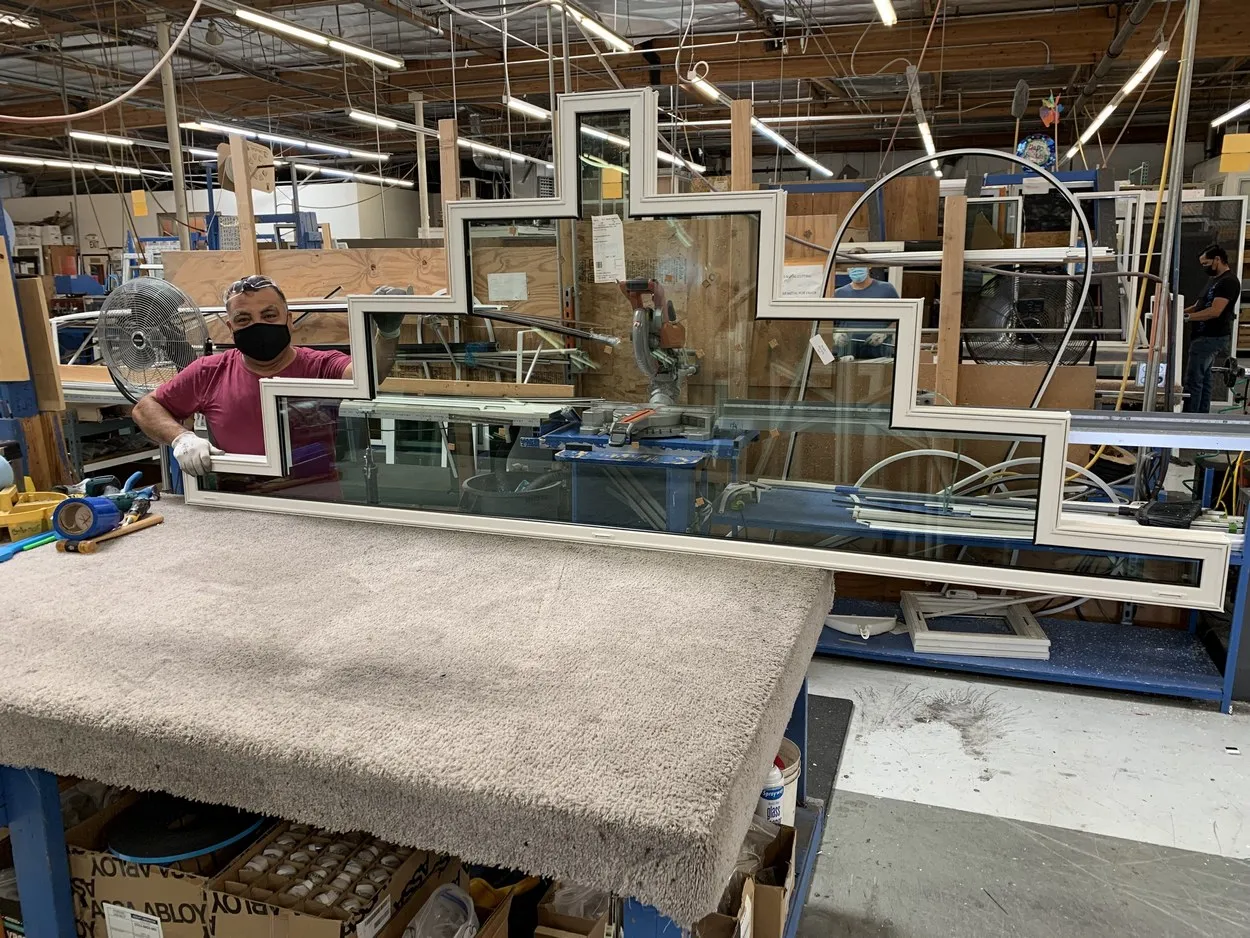
At CDW, every frame and sash corner is fusion welded. The process applies controlled heat to both vinyl profiles simultaneously until the material bonds at a molecular level, then presses the two pieces together to form a single, continuous joint.
The result is a corner that cannot loosen, gap, or admit moisture. Squareness is guaranteed by the welding fixture itself, which means every window we ship is dimensionally true. This matters because a window that is even slightly out of square will bind in its frame, create gaps in its weatherstripping, and underperform thermally (at the risk of understatement).
Maintenance requirements for a CDW window are also a direct product of this manufacturing discipline. Because there are no mechanical fasteners to corrode, no wood components to rot, and no gaskets exposed to UV degradation, our windows demand virtually nothing from homeowners over their service life.
Tilting sashes on single-hung, double-hung, and slider models swing inward for glass cleaning. That means no ladders, no exterior scaffolding, and no risk to you and yours.
Steel structural reinforcement is encapsulated within the frame and sash at strategic positions determined by each window’s size and style. Hardware integration, including our positive cam locking mechanism and supplemental security catches, is completed before the window leaves the facility, and every locking system is tested to meet the standard.
Advanced Glazing & Glass Technologies for Maximum Energy Efficiency
Glass accounts for the majority of a window’s surface area, and it is the primary pathway for unwanted heat gain in summer and heat loss in winter. How that glass is selected, treated, and sealed determines how much energy your home consumes year-round. At CDW, we treat glazing not as a commodity insert but as a precision component of our energy efficient windows.
Our standard specification begins with double-strength glass. This glass is 33% thicker than the single-strength glass commonly used in the window industry.
Greater thickness translates directly into improved acoustic damping, greater resistance to wind pressure, and a more substantial thermal barrier. From there, insulated glass units are assembled using dual-pane and triple-pane configurations depending on the performance specification required.
How Low-E Coatings, Argon Gas, and Warm-Edge Spacers Work Together
Each of these three technologies addresses a different pathway of energy transfer, and they function best when combined. Low-emissivity coatings are applied to the interior glass surfaces as a microscopically thin metallic layer. This layer reflects long-wave infrared radiation, the form of heat energy that moves through glass, back toward its source. In summer, it reflects solar heat gain outward; in winter, it reflects interior warmth back into the room.
Argon gas fills the air space between panes in place of standard atmospheric air. Argon is denser and less thermally conductive than air, which slows the convective transfer of heat between the inner and outer panes. Warm-edge spacers replace the standard aluminum spacers used in conventional insulated glass units.
Aluminum is highly conductive, creating a thermal bridge at the window’s perimeter. Our warm-edge spacers interrupt that bridge, reducing edge condensation and improving the overall U-value of the unit.
Built for the West: How Our Manufacturing Solves Regional Climate Challenges
A custom window manufacturer serving only one climate can optimize for a narrow set of conditions. CDW operates across a geographic range that includes some of the most environmentally demanding zones in the country, and our manufacturing specifications reflect that full spectrum.
Along the California coast, in communities such as San Francisco, Monterey, Fremont, the Bay Area broadly, Concord, and Sonoma, the primary threat to windows is not temperature but moisture and salt-laden air. Aluminum frames corrode. Wood frames swell and rot. uPVC vinyl is entirely impervious to both.
Our extrusions will not oxidize in marine air, and the fusion-welded corners that seal our frames prevent moisture infiltration even in sustained fog and rain cycles. The insulated glass seal carries a lifetime guarantee against failure for precisely this reason.
As an Energy Star partner, CDW windows are independently certified to meet or exceed the energy performance thresholds established for each U.S. climate zone.
Desert Performance: Heat, UV, and Thermal Cycling
In inland and desert communities, extreme UV exposure degrades standard vinyl formulations, causing surface embrittlement and color loss. Our UV-stabilized uPVC compound is engineered to resist this degradation over the full lifecycle of the window.
Thermal cycling, the daily expansion and contraction of materials as temperatures swing from early morning lows to mid-afternoon highs, is equally important. Frame materials that expand and contract at significantly different rates than the glass they hold will eventually compromise the glazing seal or distort the sash geometry.
The thermal properties of our uPVC extrusions are matched to our glazing specifications to ensure consistent, uniform movement that preserves both seal integrity and operational smoothness regardless of season.
Windows and doors from CDW are manufactured under the same quality controls regardless of which service area receives them. This consistency is only possible because every product originates from a single production environment rather than an assembly network.
Limitless Customization for Every Home Style
Factory ownership is what makes customization possible. When a window company buys a finished product from a third-party manufacturer, it is limited. Specifically, it is limited to the sizes, shapes, and configurations that the manufacturer chooses to produce.
At CDW, we produce varieties of colors, shapes, and sizes to fit our clients’ needs. Why? Because our engineers control the tooling, the extrusion dies, and the production schedule.
Our window range includes bay, bow, garden, casement, single-hung, double-hung, curved, sliding, and commercial configurations, along with obscure glass options and architectural grid patterns. These can be applied to virtually any frame style.
Stacked and combination configurations can be engineered to meet specific architectural requirements that no catalog product could accommodate.
Liquid Wood, Custom Finishes, and Coloring Capability
Our factory finishes extend well beyond white and almond. Custom colors, painted finishes, and our Liquid Wood laminate complement historic homes, modern facades, and personalized architectural styles.
Our factory applies and cures every finish under controlled conditions for lasting durability and warranty-backed protection.
CDW reviews frequently praise custom configurations homeowners believed were unavailable at competitive prices. Factory-direct manufacturing allows us to build non-standard sizes, unique shapes, and specialized hardware without significant lead times.
Our Window Manufacturing Safeguard: The No-Fine-Print Lifetime Warranty
A warranty is only as strong as the manufacturing process it backs. Because CDW controls every stage of production, from raw material sourcing through extrusion, glazing, and assembly, we are in a position to stand behind our product with a coverage commitment that few replacement window companies can match.
What Our Lifetime Coverage Actually Includes
White and almond uPVC vinyl extrusions are covered under a Full Lifetime Non-Prorated Warranty for as long as the original homeowner owns the property. Other colors, painted finishes, and laminated vinyl extrusions, along with parts and labor, are covered for ten years.
The insulated glass unit carries a lifetime guarantee against seal failure, one of the most common points of long-term window degradation. When a home is sold, our warranty is transferable to the new owner upon inspection, adding measurable value at the point of sale.
There are no hidden exclusions designed to limit claims. This commitment is only sustainable because our window manufacturing process does not rely on components or assemblies we do not control.
Every specification decision, from extrusion wall thickness to the composition of the glazing spacer, is made in-house, which means we know exactly what we built and exactly what it was built to withstand.
Ready to See Factory-Direct Quality for Yourself?
CDW has served homeowners since 1999, and every window we have installed reflects the same manufacturing discipline that governs our facility today. Whether you are replacing a single casement in a Victorian or retrofitting an entire home, we can guide you through every design, performance, and budget consideration.
Schedule your complimentary in-home estimate and experience the difference that 30 years of manufacturing expertise makes.
Window Manufacturing FAQs
What makes California Deluxe Windows different from other window manufacturers?
California Deluxe Windows manufactures its own windows from raw materials to the finished product, giving the company complete control over quality. This factory-direct approach helps ensure consistent craftsmanship and long-lasting performance.
Why is uPVC vinyl a good material for replacement windows?
uPVC vinyl resists moisture, rot, termites, rust, and corrosion while requiring very little maintenance. It also includes UV-resistant additives that help preserve the window’s appearance over time.
What is fusion welding, and why does it matter?
Fusion welding permanently bonds window frame corners at the molecular level instead of relying on screws or adhesives. This creates stronger, tighter corners that help prevent air leaks and moisture intrusion.
How do CDW windows improve energy efficiency?
These windows combine Low-E glass coatings, argon gas fills, and warm-edge spacers to reduce heat transfer. Together, these features help maintain comfortable indoor temperatures and may lower energy costs.
Are these windows designed for different climates?
Yes. California Deluxe Windows manufactures windows that perform well in coastal, desert, and inland environments.
Can I customize my new windows?
Yes. Homeowners can choose from a wide range of window styles, sizes, colors, finishes, and decorative options to complement their home’s architecture.
What is the Liquid Wood finish?
Liquid Wood is a factory-applied wood-grain finish that gives uPVC windows the appearance of real wood. It provides a classic look without the maintenance requirements of traditional wood windows.
Do California Deluxe Windows require a lot of maintenance?
No. Their uPVC construction resists common issues like rot, corrosion, and fading, making maintenance simple. Many models also feature tilt-in sashes for easier cleaning from inside the home.
What kind of warranty comes with CDW windows?
California Deluxe Windows offers a lifetime warranty on qualifying white and almond uPVC vinyl extrusions, along with additional coverage for insulated glass and other components. Certain finishes and labor are covered for specified warranty periods.